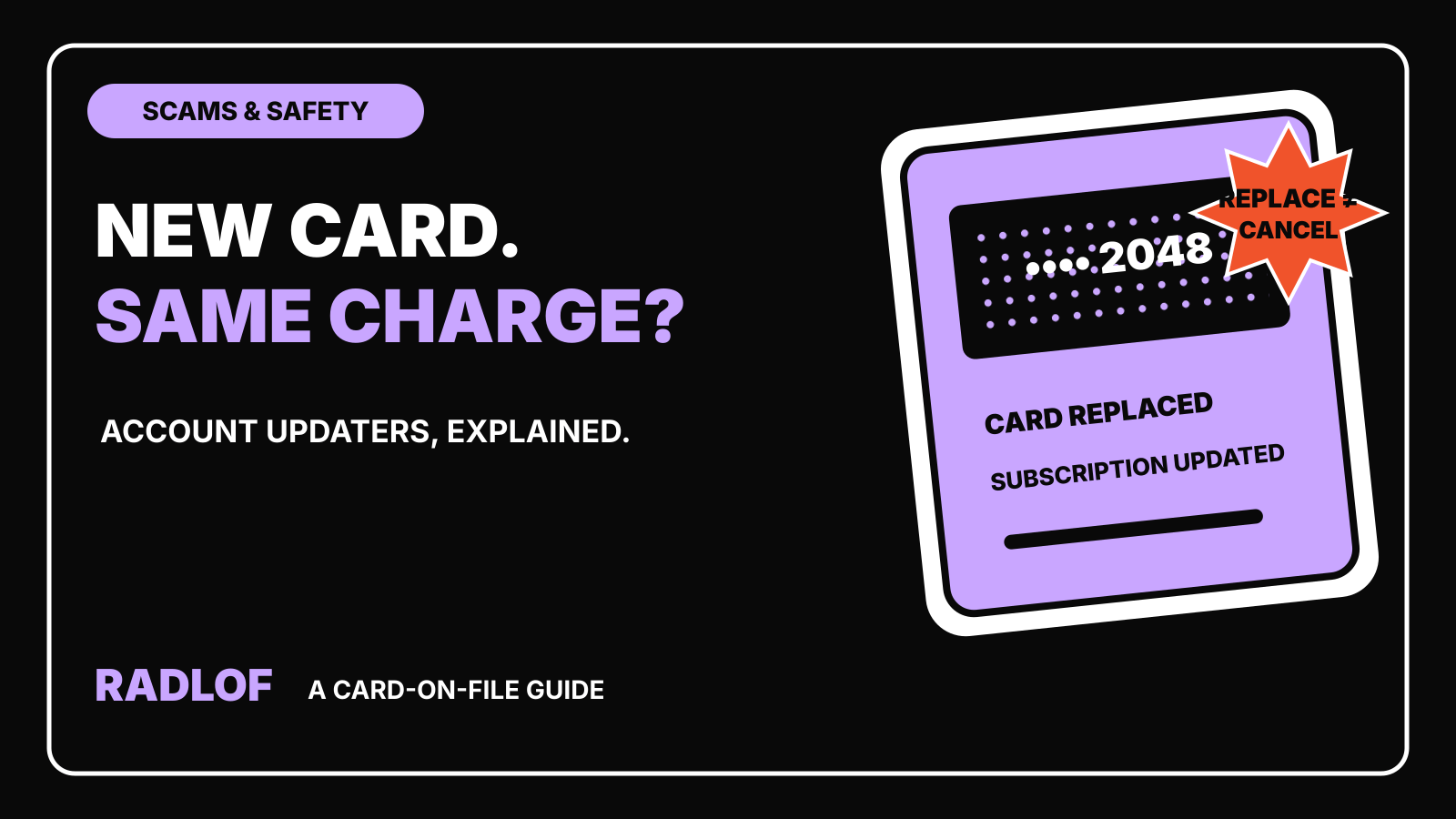
A replacement card does not always stop a subscription or other card-on-file charge. Visa and Mastercard operate account-updater programs that can pass a new card number or expiration date from a participating issuer to a participating merchant. That is why a merchant may keep billing after your physical card changes.
If you want a subscription to end, cancel it with the merchant and keep the confirmation. Replacing the card is a security step, not a dependable cancellation method.
Why a charge can follow the new card
Recurring and card-on-file merchants save a payment credential for later transactions. When the underlying card expires or is reissued, a network updater can provide current account details so legitimate payments do not fail.
Visa’s Account Updater documentation says participating issuers, acquirers and qualified merchants can exchange updated account information for recurring and credential-on-file payments. Supported events include renewal, replacement, upgrades, lost or stolen cards and account closures.
Visa describes the flow in four steps: the card details change, the issuer shares the update, the merchant or acquirer asks for current information, and Visa returns the update so the merchant can refresh its billing file.
Mastercard’s Automatic Billing Updater privacy notice describes the same practical result: an acquirer or merchant may receive an updated account number and expiration date when a saved card expires or is renewed.
The updater is meant to prevent avoidable service interruptions. It can also surprise someone who assumed a new piece of plastic would sever every existing billing relationship.
Replacement is not cancellation
There are three separate actions:
- Replace the card. The issuer changes the card credentials because the card expired, was lost, stolen or compromised.
- Cancel the merchant agreement. You tell the subscription or service provider to stop future billing under its cancellation terms.
- Dispute a charge. You ask the issuer to investigate a specific transaction because it is wrong, unauthorized or the merchant did not honor the agreement.
One action does not automatically complete the others. A card replacement may leave a valid subscription agreement in place. A subscription cancellation does not necessarily reverse a charge already earned under the merchant’s terms. A dispute addresses a posted charge; it is not a general subscription manager.
What information gets updated
Visa says its updater can provide a changed primary account number, a new expiration date, a closed-account status or an instruction to contact the cardholder. It does not provide a changed name or address through this service.
Mastercard’s notice lists the old and new account number and expiration date as information processed for its updater program. Participation and available choices can vary by issuer, merchant and country.
That means two subscriptions on the same card can behave differently. One merchant may receive the new credential automatically while another gets a decline and asks you to update the card manually.
How to stop an unwanted recurring charge
Start with the merchant, unless you believe the charge is fraud.
- Sign in through the merchant’s official site or app. Do not use a cancellation link from an unexpected message.
- Cancel the subscription or recurring agreement under its stated process.
- Save the confirmation screen, email, effective date and any ticket number.
- Remove the saved card if the account offers that control.
- Review the next two statements for another charge.
- If billing continues, contact the merchant with the cancellation evidence and then the card issuer.
If the merchant has disappeared, refuses to cancel or keeps charging after the effective cancellation date, call the issuer using the number on the back of the card. Describe the dates and provide the cancellation record.
Do not report a charge as fraud merely because you forgot the merchant name. First compare the statement descriptor with receipts and subscription emails. But if you did not make or authorize the transaction, contact the issuer immediately.
If money is already missing and you do not recognize the transaction, use Radlof’s first-hour account theft checklist while the details are still fresh.
What to do after a lost or stolen card
Report the card to the issuer immediately and follow its fraud instructions. Visa’s lost-card guidance tells cardholders to cancel the missing card, request a replacement, review statements and update recurring payments after the new card arrives.
That advice is compatible with account updaters: not every merchant participates, so essential bills can still fail. Make a list of rent, insurance, phone, utilities, software and other services that rely on the old card. Check each one rather than assuming every credential updated or none did.
For a compromised card, ask the issuer whether automatic updater services affect the replacement and what options it offers. The correct answer is account- and issuer-specific; the network documentation does not promise a universal consumer opt-out in every market.
How to dispute a wrong credit-card charge in the US
For US credit cards, the Consumer Financial Protection Bureau’s billing-error guidance recommends contacting the issuer and following up in writing as soon as possible.
The written notice must reach the billing-dispute address no later than 60 days after the issuer sent the first statement showing the error. Include your name, address, account number and a clear explanation. Keep a copy and pay the undisputed part of the bill on time.
The CFPB says the issuer has 30 days to acknowledge the letter and two billing cycles to finish investigating. Those are US credit-card rules; debit-card procedures and rights differ, and other countries use different laws.
A simple account-updater checklist
When a card changes, sort merchants into three lists:
| Keep paying | Cancel | Investigate |
|---|---|---|
| Essential services you still use | Subscriptions you no longer want | Names or amounts you do not recognize |
| Confirm the new credential or next due date | Cancel through the merchant and save proof | Contact the issuer; do not click an unexpected message |
| Watch for a decline or interruption | Check later statements | Preserve receipts, emails and statement details |
This is faster than treating the new card as a clean slate. It also reduces the chance that insurance, phone service or another important bill fails while an unwanted subscription continues.